
VO2 max for beginners

Let’s start with simple terms. We wake up every morning, eat breakfast, go to work, maybe train after coming home, eat, rest and sleep. The same or a similar cycle repeats for most of us.
In physics, in order to move an object from A to B, we need energy. We need energy to drive a car from home to supermarket. Here, the energy comes from the car engine, let’s say from firing petrol. In order to burn the petrol, we need a spark and oxygen.
For simplicity purposes, we can say that our body is an object and it has all moving parts (organs) that work non-stop until we die. They are working even if we are not doing anything, just lying on the sofa. The heart is pumping, the stomach is digesting, the brain is thinking. All the organs are in movement and require energy. This is called resting energy demand or resting metabolic rate.1
Any additional movements like going for groceries, driving, or sitting at a desk - require additional energy. Walking a few km requires a bit more energy and running a few km demands even more energy. Basically more movement = more energy demand.
As the car needs oxygen to burn the petrol, our body needs oxygen too. Our body uses carbohydrates (bread, rice, vegetables etc.) as primary fuel. Fat is also used as fuel but our body prefers carbohydrates. It burns faster. It is like burning a piece paper vs a large piece of wet wood.
Let’s say that we have enough carbs but it doesn’t help if we don’t have enough oxygen. It is like putting a lot of paper into the bin, lighting a fire and putting the lid on. When there is no oxygen, there is no fire. When there is no fire, there is no energy.
VO2 max is basically how much oxygen your body is capable of using at a given time. Let’s say per day or hour. VO2 stands for V - volume, O2 - oxygen, max - maximum: Maximum volume of oxygen that can be utilized in a unit of time. It is usually measured in litres because a measurement unit for gases is a litre.
In order to make it easier to measure we use amount of oxygen the body is capable of using every minute. Hence litres per minute (L/min). It is measured like 4L/min, 5L/min etc. We almost never experience maximum usage of our capacity. If I say my VO2 max is 4 L/min, I almost never use it, unless I am doing a specific VO2 max training session. Putting the body under maximum oxygen demand is very hard and mentally tough.
Measuring the VO2 max in litres per minute gives us a one-sided picture. In order to be able to compare we use it relative to body weight. Because one person with 100kg body weight and 4 L/min VO2 max is totally different than a 50kg person with 4 L/min VO2 max. Why is that so? Let’s remember the energy demand to move an object from A to B. Moving the 100kg body requires much more energy than moving the 50kg body. Hence, available oxygen is the same but energy demand is much lower. We get better fire (more energy) with that 4 L/min oxygen.
Therefore, a relative value ml/kg/min is used. This makes it easier to compare. For the 100 kg person their relative VO2 max is 40 mL/kg/min while for the 50 kg person it is 80 mL/kg/min. There is a HUGE difference between the two.
Before diving into gender and age differences or how to improve our VO2 max, let’s talk about how to measure it.
There are a couple of different ways to measure it. The best one is using standardised tests in an approved lab. A special face mask is used for that purpose. The mask is connected to a special machine which measures every inhale and exhale. Each breath contains O2 and CO2. It calculates how much O2 we are breathing in and breathing out, giving us real-time data every minute.
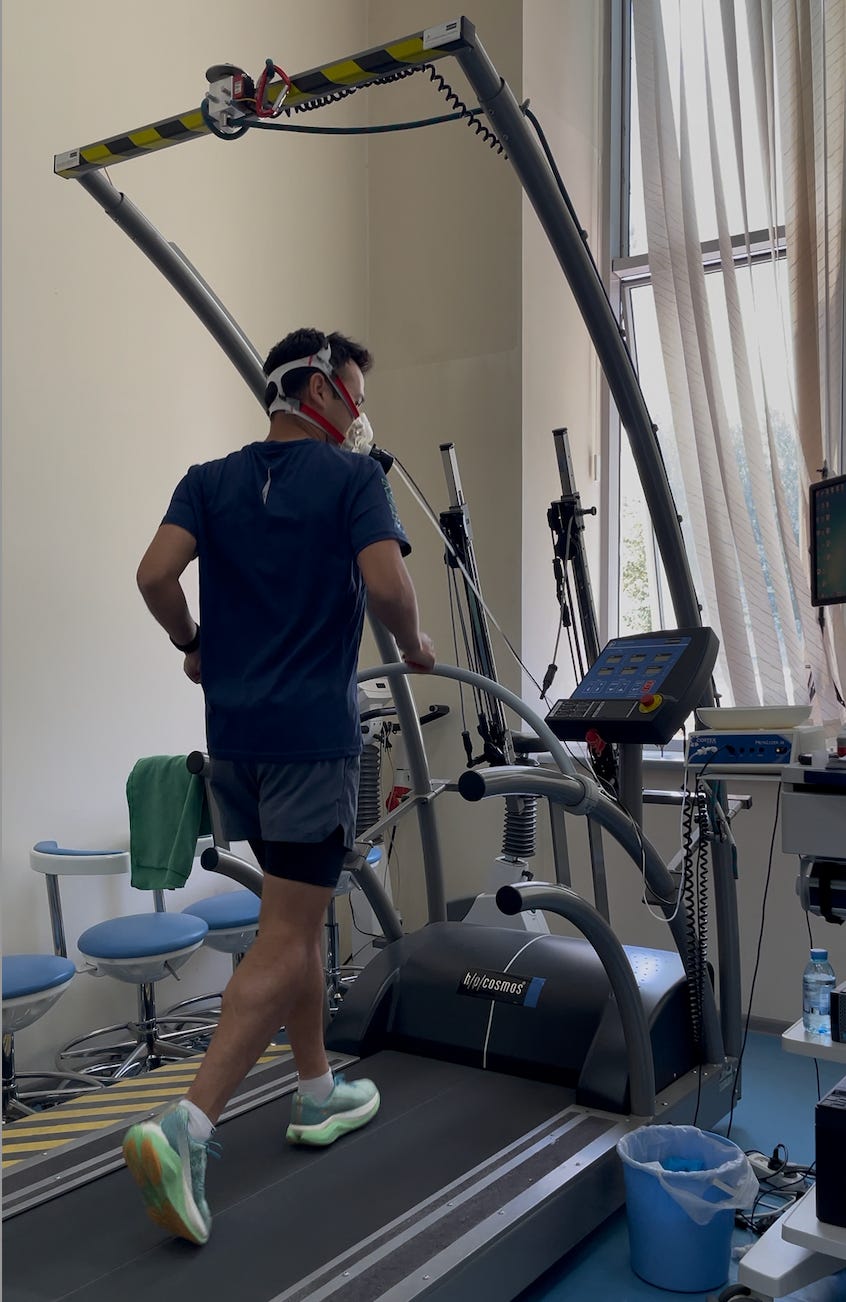
The test is usually done on a treadmill or a stationary bike. The test starts in low speed and uses a ramp-up technique, for example, increasing the speed by 1 km/h every 3 or 4 minutes. There are different variations, but the main point is to increase the oxygen demand until the body says no more, meaning total exhaustion.
The lab method is the most accurate one, also the most expensive, costing from about 100USD and upwards per test depending on location.
Free VO2 max test
There are other indirect methods too. One is the Cooper test. Free and a good starting point to find out your estimated VO2 max. The test is done in the following steps:
1. Choose a flat surface, best if it is a running track. Warm up with walking and an easy jog for 10-15 minutes.
2. Run as far as possible in 12 minutes. It should be exactly 12 minutes.
3. Cool down with an easy jog for another 10 minutes
4. Calculate your VO2 max. Let’s say that you ran 2400 meters (6 laps in a 400m track), then use this formula. (2400 - 504.9) ÷ 44.73 = 44.2 mL/kg/min. If you ran 2000 meters (5 laps) then your estimated VO2 max is 33.42 mL/kg/min. Or just google and online calculators pop-up.
Untrained people can’t pace themselves and run very fast in the first minutes and then having to slow down later. It is important to keep a steady pace. The good news is it can be re-tested. Please, don’t do this test back-to-back. It is heavy for the body and you increase the injury risk.
If you have one of the modern sport watches (Garmin, Coros or similar) and have been doing both slow and fast runs, they give very close estimates. I would even say you don’t have to do the lab test if you are not a nerd like me. You can safely rely on your watch. Garmin refers to the Cooper institute when they use the VO2 max charts.
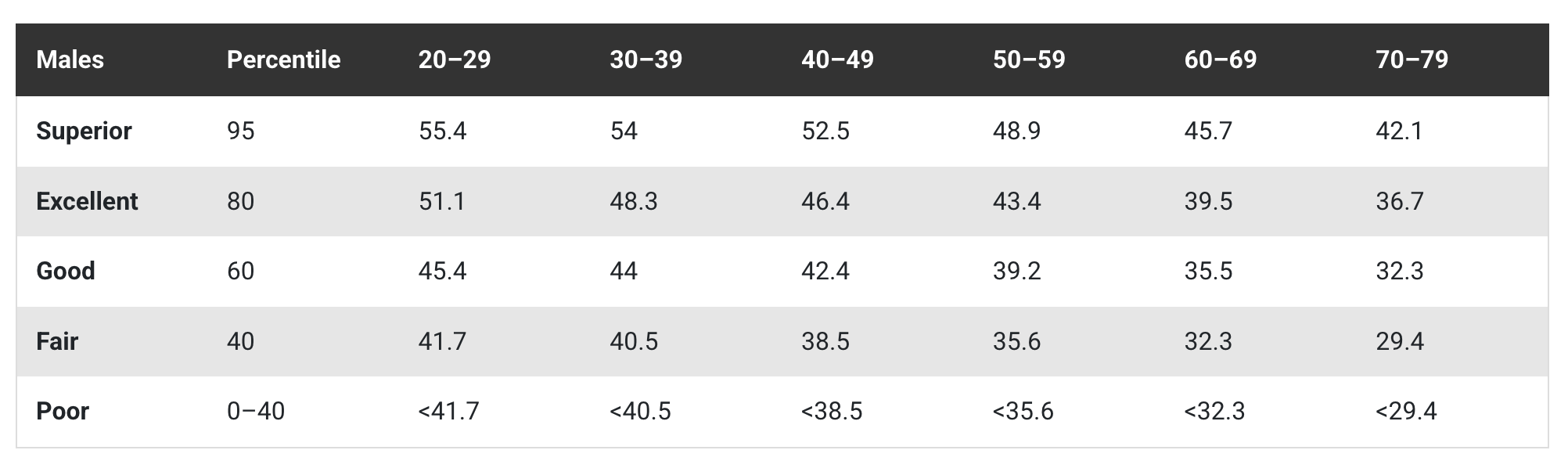
Statistically men have higher VO2 max than women. Some people are genetically gifted with higher VO2 max levels.
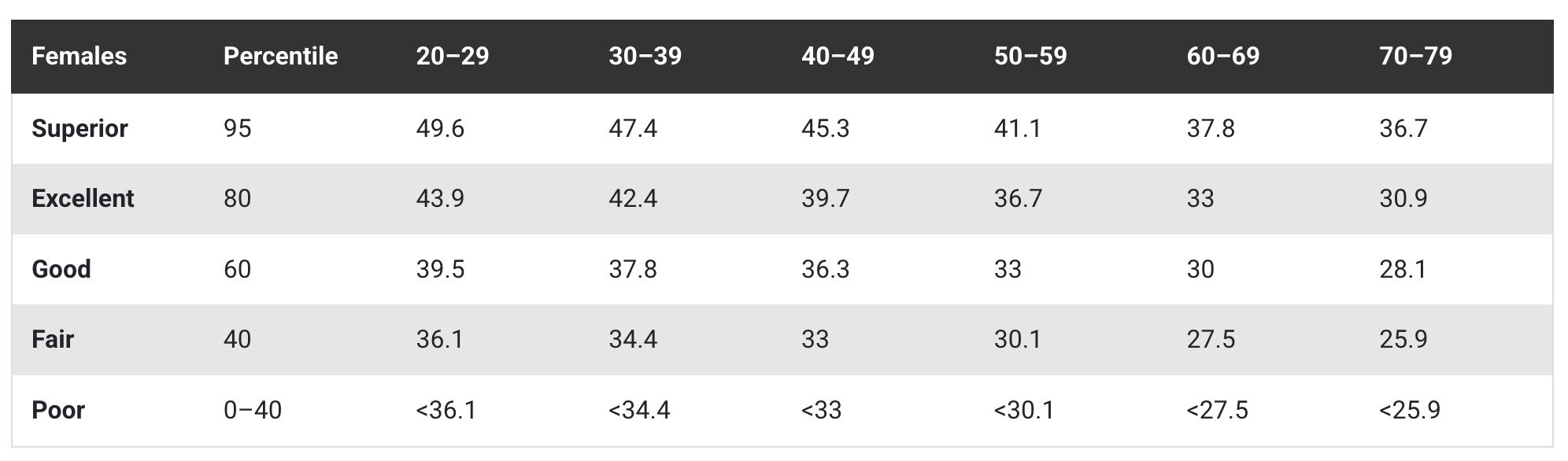
The VO2 max increases with age peaking in twenties and then decreasing about 10% per decade of life. In each age group there are different categories. For example, 52.5 ml/kg/min VO2 max for my age (38) is considered excellent. If I am able to keep this VO2 max values until I am 45 then it will put me in the superior category. The best triathletes have VO2 max over 80, Blummenfelt measuring 96ml/kg/min. Other two norwegians with high records ever are skier Bjørn Dæhlie (96) and a cyclist Oskar Svendsen (97.5).
There are many scientific studies confirming high VO2 max is associated with lower risk of dying from all causes, young or old.2
That being said, it is not all about VO2 max. High VO2 max is a big bonus of course but it is not something that wins races as a standalone factor. Focusing too much on VO2 max can be a mistake.
Can VO2 max be improved?
The short answer is yes. Many claim that one has to do a lot of all out, high intensity interval training sessions to improve VO2 max, sessions like the 4x4, aka the Norwegian Method. However, many of those claims fail to mention that one has to build a solid aerobic base before attempting high intensity sessions. Those VO2 max sessions can be done, but should be done rarely and with caution. Even the elite endurance athletes do their most of the training volume (as high as 98%) in low (green) zones.
Many people do all out high intensity training sessions every week. In fact, the VO2 max sessions should be kept for special, pre-race occasions. It is almost never necessary to have all out sessions so frequently.
Why is that so? Because those sessions are very heavy on the body requiring longer recovery time. It also increases the injury risk.
Key for amateurs like us is to stay in the game and keep moving as long as possible without disruptions.
The biggest win for us is keeping the training chain unbroken.
If VO2 max was something new for you, then just focus on easy and frequent training. The rest comes afterwards.
Feel free with your questions.
Stay healthy,
Bek
There is a slight difference between basal metabolic rate (BMR) and resting metabolic rate (RMR). BMR is the energy required to keep the body alive, while RMR includes small activities like getting up, making coffee etc. It is usually about 10% more than BMR.
Mandsager et al., Association of Cardiorespiratory Fitness With Long-term Mortality Among Adults Undergoing Exercise Treadmill Testing https://pubmed.ncbi.nlm.nih.gov/30646252/
First off great post! Love the well written context and then learning there is a way to estimate VO2 Max with formula based on 12 minute run. Further I love that you are taking Gordo Burn’s 1,000 day journey and documenting it on your own path. Your insights are inspiring and a. make me want to join you on your 1,000 path b. How would I foment - analyze that path in my own writing. Well done!
Rahmat aka, menga shu kerak edi. Ertaga ertalab shu bepul hisoblashni, amalda qo'layman va chiqgan javobni shu yerda yozib qoldiraman.🫡