
habit creation
we don't understand compounding

2025 is almost over. So many people are waiting for January 1st to start a new habit. Whether we like it or not, this is the reality.
The other day, Gordo and I talked about habit creation. In this post, I will share some practical tips.
We overestimate what we can do in a day
We want to be productive. We want to get so many things done in a single day. From a student’s perspective, this would look like this: wake up early, study before breakfast, attend college, hang out with friends, hit the gym, work the part-time job, come home, curate social media, watch some entertainment, study, get at least 8 hours of sleep. Maybe dating in between.
For a working man, this might look like this: wake up early, read a book, a healthy breakfast with your family, productive work, minimum commute time, training after work, a family dinner, bedtime reading for your kids, no work at home, quality time with your spouse after kids’ bedtime, get at least 7 hours of sleep.
We cram so many things into a single day, we rarely get much of it done. We end up frustrated, and scrolling social media before bedtime. In the worst-case scenario, watching Netflix or scrolling Instagram with a glass of booze in hand, sitting alone on the sofa at midnight, knowing that we have so much planned for tomorrow, the day after tomorrow and the day after… We want to change, we know what we should change but it is not easy.
We underestimate what we can do in a year
Gordo mentioned that one should lower the bar so much that a small thing can be considered a win. For example, a 5-minute walk is considered as a win of the day. Not 5km running, just a 5-minute walk. Or waking up before 7 a.m. is a big win. Or no phone use upon waking up, wait at least 15 minutes to pick it up. Or keeping the phone outside of the bedroom. We are not talking about deleting social media or reducing the screen time drastically. Small wins every day stack up and result in big positive changes.
I like things to be visible. I like tracking changes. About 3 years ago, I came across a post by Mr. Money Mustache, a guy who retired at 30 and has been writing about financial independence and retiring early ever since (he is 50 now). He wrote about building and tracking new habits. In that post he shared his approach and a chart he used. I adopted his chart for myself and have used to create new habits. It helped me a lot. Here is the chart I am using now.
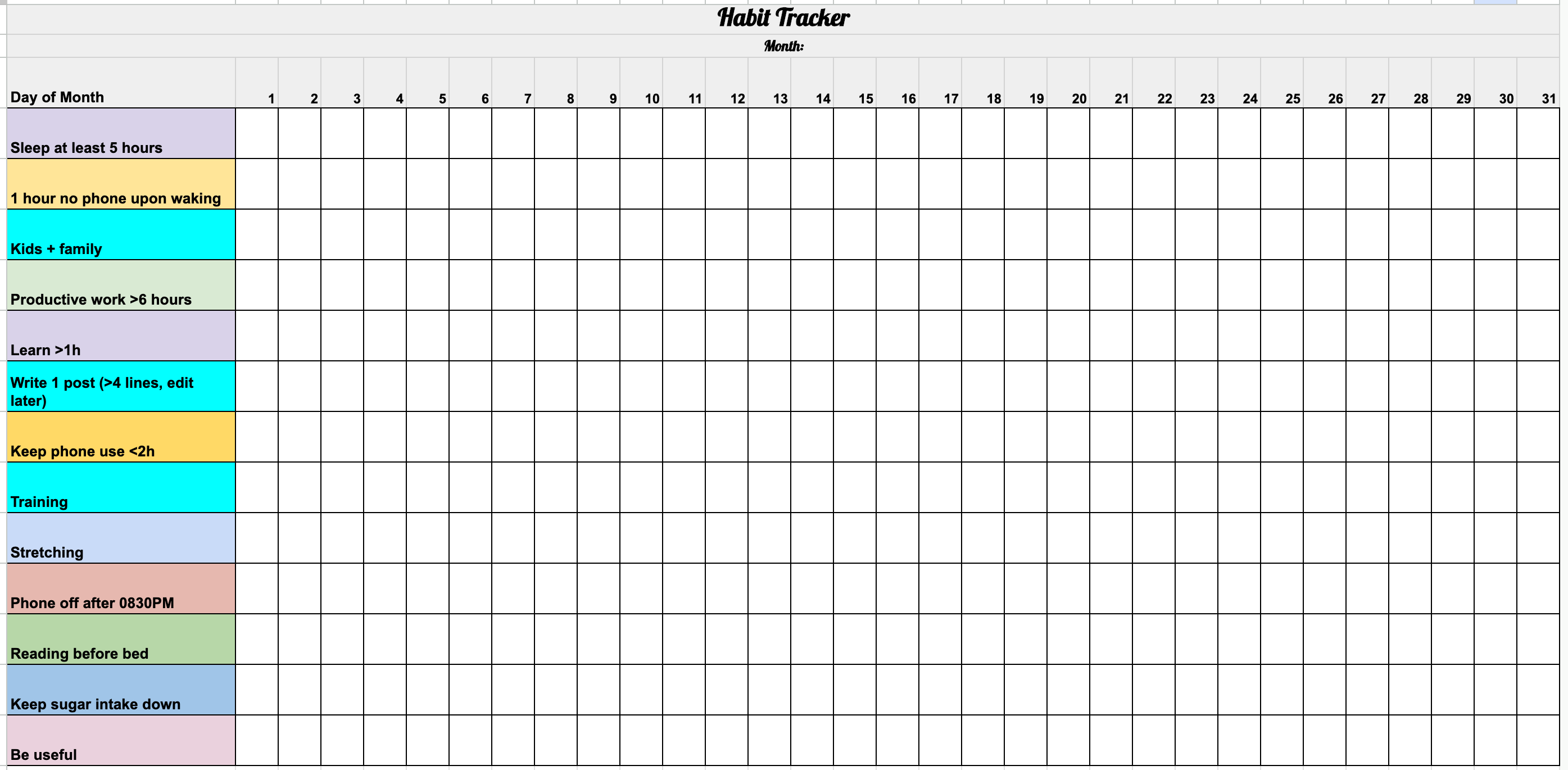
It is simple, printed out and hangs on the kitchen wall. It is visible to everyone in the family.
I consider myself a disciplined person. However, bad habits kreep in slowlwithout us noticing them. Sometimes we need a reset. This habit tracker helps me to reset some bad habits, e.g. picking up the phone upon waking. I am sure there are some apps that serve the same purpose but I like to keep it simple and visible all the time. You can copy the table from here and make any changes you want.
Many things on the chart are habits I am already doing everyday, e.g. training and learning. However, it is a good reminder for myself that I can do better. My goal is to have all the 403 (13x31) squares filled with “+”. It gives satisfaction and motivates me.
One can start with only ONE habit. Just have ONE small habit for 30 days, track it down. Next month, add another ONE small habit. What habits to create is entirely up to you. For someone else, the chart might look like this.

It is important to remember “10-80-10” rule that I wrote about earlier.
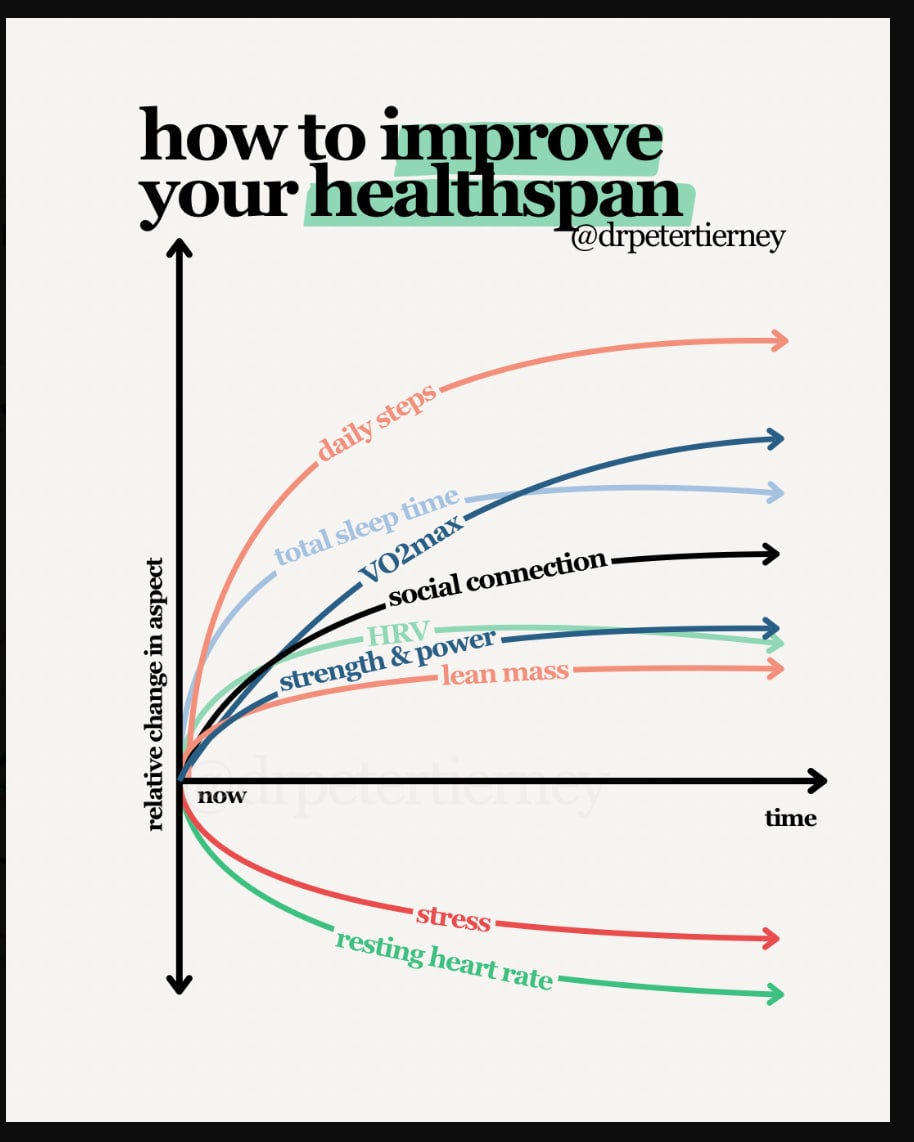
One thing we don’t realize enough is compounding effect of our habits. One small change everyday compounds over time. A nice visualisation of the compounding effect of different factors by Peter Tierney
Back to my habit tracker. One simple habit of not using my phone upon waking gives me at least 20 extra with my wife every month. At that time, kids are asleep and we can have good conversations during breakfast. Fresh minds with fresh coffee, both with positive mood. That guarantees a really good start for the day.
Or another example, writing one post every day, at least 4 lines, published or not - produces 30 posts. Each post I’ve written on Substack has been viewed 5,000+ times on average. On my Telegram channel each post is viewed 20k times. I have been publishing on Substack twice a week since October 19 (just over 2 months) and now 3,6k subscribers from 96 countries are reading my posts. These are some crazy numbers.
We underestimate compounding effect of our small habits.
Make one single change today, and track it for at least 30 days.
Stay healthy,
Bek
"We are what we repeatedly do. Exellence is not an act, but a habit."
The 30 days track is wonderful idea. I am on my second year of circling through a 30 day challenge on personal craft.
One of the things that has helped was the idea of self evaluation(something you elude to in a previous post) then true to Gordo’s advice on lower bar(I listened to a podcast he was in on the first cycle).
I think the trap that people often fall into is after every 30 days they lose heart and revert to old ways( I certainly have too).
Anyway, i great post, it’s motivating to get out of the analysis paralysis i have been in to work in public.